
Fig. 1 Eugène Carrière Tête d'enfant endormi c. 1901 Oil on canvas 41 × 33 cm

Eugène Carrière
Gournay-sur-Marne 1849 – 1906 Paris
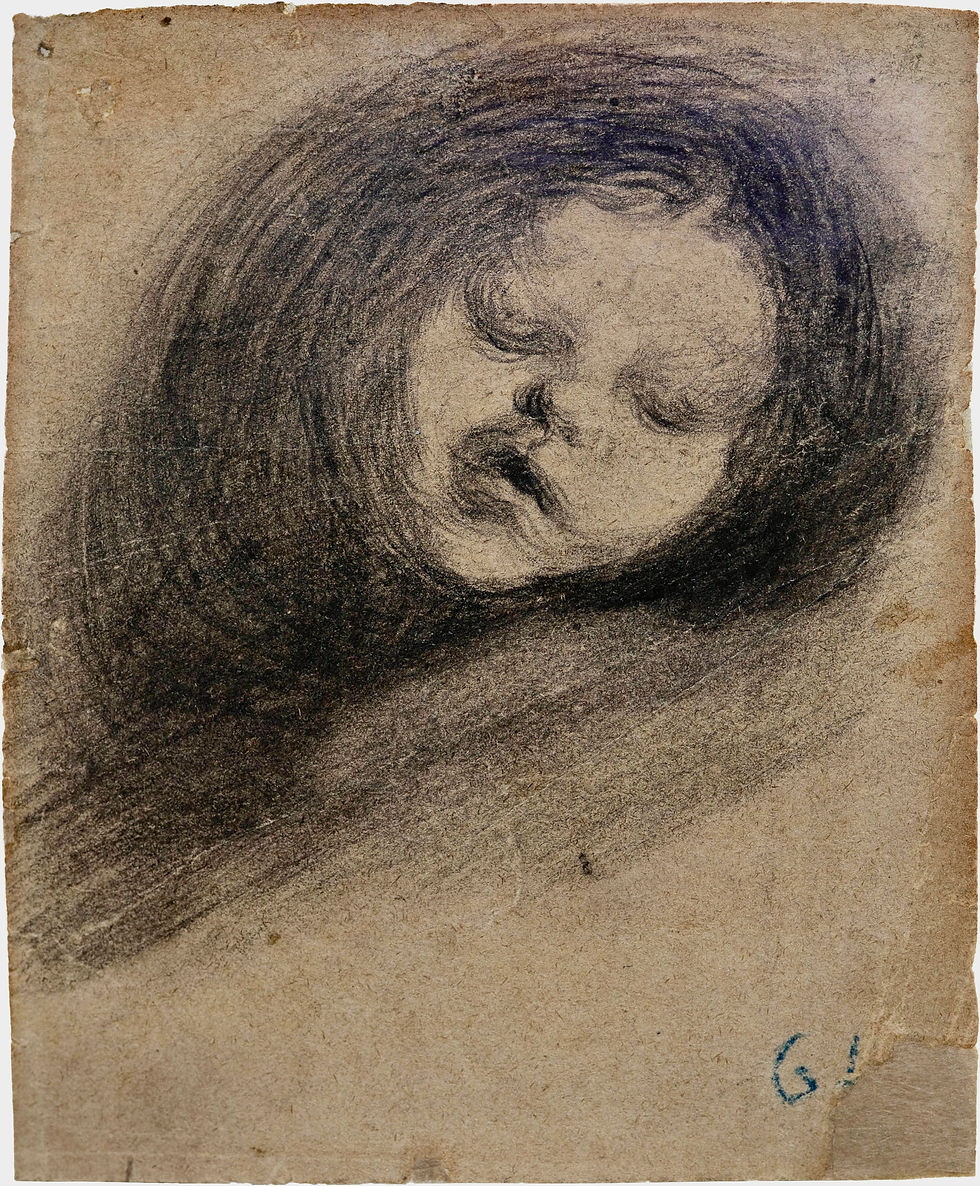
Sleeping Baby
Charcoal and stumping on paper
110 × 90 mm
Annotated (lower right): “6 I”
Eugène Carrière’s work is distinguished by soft tonal transitions and blurred contours, with his graphic œuvre displaying his ability in making forms emerge gradually from shadow.
In the early 1890s, Carrière began translating the effects of lithography into painting, working and reworking the surface to achieve a smoky, unified tone. This rejection of realistic colour puzzled many critics but was admired by artists such as Paul Gauguin and Maurice Denis. As Albert Besnard famously remarked, “One day people will speak of Carrière’s Maternités as they do of Michelangelo’s Pietàs”.
Our intimate drawing depicting the head of a small sleeping child belongs to the realm of Carrière’s Maternités and studies of children, more specifically to a series of sleeping babies he produced in the early 1900s. Executed in charcoal on paper, the drawing is built up through soft, layered strokes that create subtle gradations of tone. The contours are deliberately diffuse with the figure emerging from a darkened ground, typical of Carrière’s atmospheric handling.